Use Case 2 - 6G resilience, service continuity and automatic recovery in disaster scenarios
As the 6G network provides a plethora of services towards its users, resiliency with respect to the communication infrastructure becomes a salient feature. To address this, 6G-CATS focuses on several key challenges aimed at enhancing network robustness and reliability. The integration of terrestrial (TN) and non-terrestrial (NTN) data planes will provide a communication fallback mechanism, ensuring service continuity and supporting disaster recovery scenarios. In addition, an NTN air corridor, enabled by drones equipped with fiber-grade optical wireless communication (OWC) capabilities, will offer supplementary backhauling and dual-connectivity options.
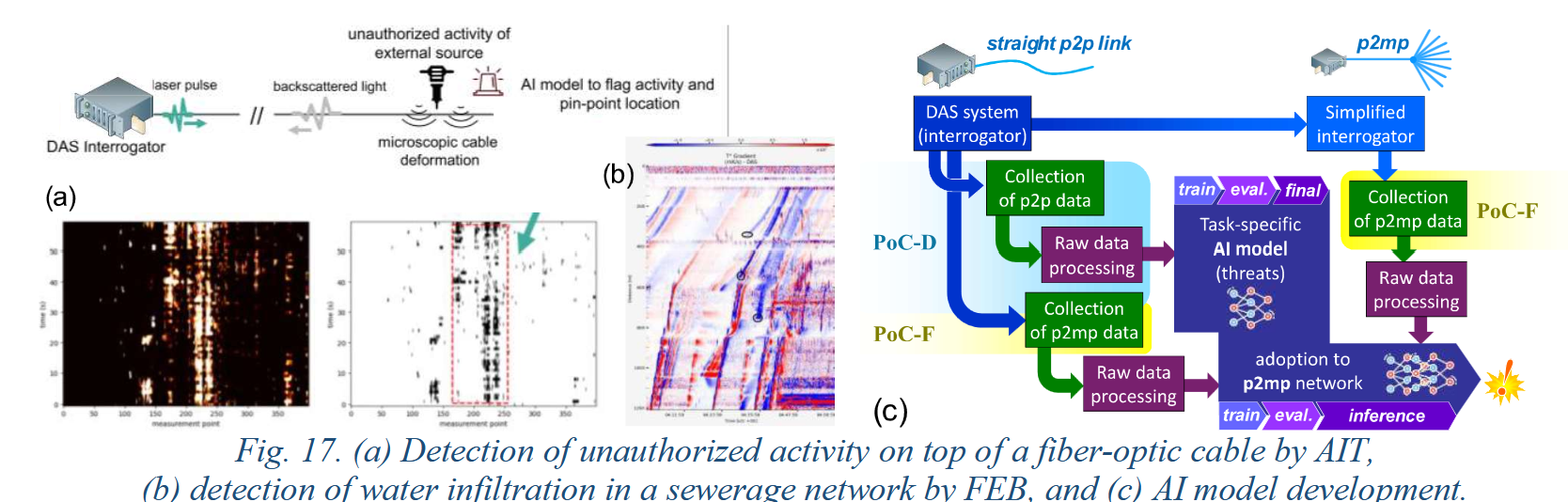
Threats to the physical-layer infrastructure will be detected through the integration of multi-modal optical sensing technologies combined with AI, enabling the identification of imminent risks such as construction activities near critical fiber infrastructure, as well as environmental hazards including water infiltration in street cabinets. Furthermore, AI-driven analysis of large-scale network telemetry will support continuous network health monitoring and fault prediction, allowing the infrastructure to proactively identify anomalous network elements before failures occur. Finally, data collected from roadside sensors will be leveraged to detect degraded network assets, such as physically damaged cable pylons, further strengthening the resilience and operational reliability of the 6G communication infrastructure.