Use Case 1 - Connected Mobility
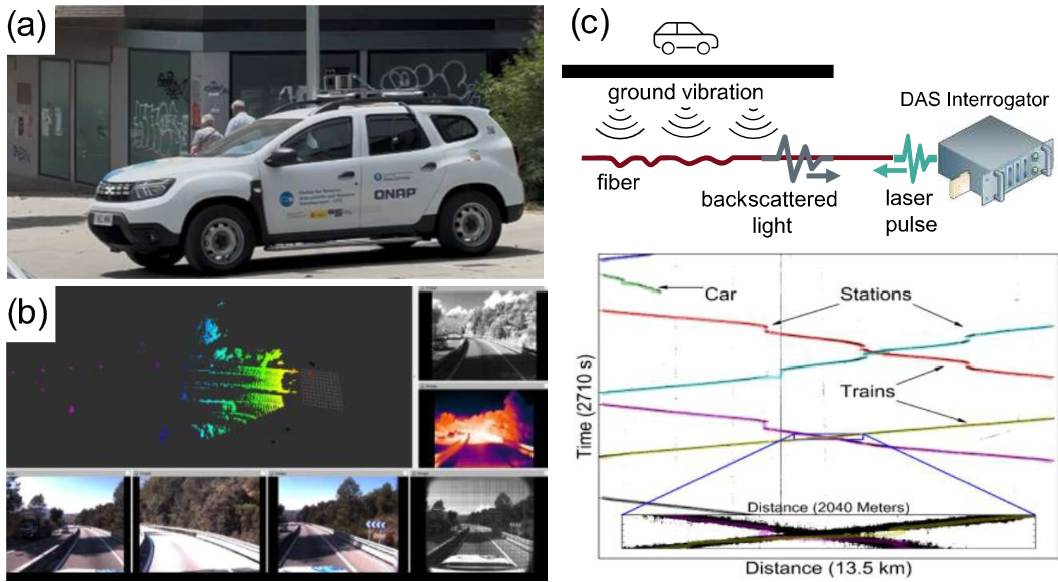
Low-latency 6G communications have the potential to redefine urban mobility by improving road safety, reducing travel times, and enabling more sustainable transportation systems. 6G-CATS will develop novel algorithms to enhance connected mobility through the fusion of distributed and local sensing technologies deployed across both infrastructure and vehicles. The solution combines distributed acoustic sensing (DAS) embedded in the communication infrastructure, fixed roadside sensing using LiDAR and cameras, and mobile sensing from connected vehicles equipped with radar, LiDAR, and cameras. Advanced AI-based perception algorithms will be developed to detect and classify vulnerable road users (VRUs), including pedestrians, cyclists, and micromobility users, by exploiting multimodal data collected from instrumented vehicles for model training and validation. Furthermore, vehicle tracking capabilities will be enhanced by adapting and retraining existing AI-based DAS tracking algorithms for road transportation scenarios.
The fusion of multimodal information from multiple sensing modalities and advantage points will provide a comprehensive understanding of the driving environment that extends beyond the capabilities of individual sensors. At the infrastructure level, integrated sensing and communication (ISAC) modules deployed on roadside furniture will continuously provide traffic information to the 6G edge-cloud continuum, balancing efficiency, safety and reduction of emissions. Finally, the platform will support the safe integration of sustainable micromobility services, such as e-scooters and e-bikes, through real-time conflict detection and avoidance mechanisms, while enabling seamless handover between different transportation modes and public transit via continuous 6G-enabled monitoring, dynamic routing, and capacity management.